Train your pet to use a pet door

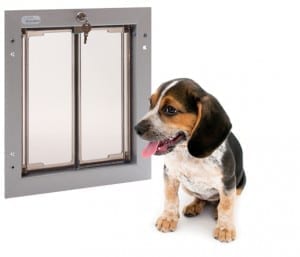
Train your pet to use pet door. This Beagle uses the medium PlexiDor Dog DoorMost pets take to their cat door or dog door quickly. They are eager to be outside, and love the option to go in and out whenever they want to. Some pets are intimidated by the door at first, but with a little patience your cat or dog will learn to use the door. Most pets learn in between five seconds and five days.

The PlexiDor is different from traditional cat flaps and dog doors in many ways. The difference most important from the pet’s point of view is that your cat or dog can see through the panel. Many cats and dogs like to lie just inside the door and peek out at what’s happening outside. Being able to see through also makes it easier for many pets to learn to use the door – they can see the outside, and they want to get there.

If the pet doesn’t take to the door, try propping one of the panels open and tempting the pet with a treat. If the pet is reluctant, start with propping both panels up. Never force your cat or dog through the door, and give praise once they do come through. Be patient – they’ll get it.

For the electronic door, it usually works well to put a treat on the bottom lip of the pet door. The dog or cat approaches to get the treat, and the collar key triggers the door to open. It doesn’t take long for the pets to figure out that the door will open when they come close to it.

//youtu.be/bi01-eLGF7s

Dog training tips, part 2

In yesterday’s post, we mentioned five dog training tips. Here are five more that will hopefully make training and everyday life easier.

1. Have realistic expectations

Changing a behavior takes time, especially if it’s a deeply rooted habit that has been going on for a long time. Re-training an adult dog takes longer than teaching a puppy the first time. It is never too late to change a behavior, but some things will take longer than others.

For example, if you’ve allowed your dog to jump up to greet people for five years,  but decide that the behavior isn’t okay anymore, it will take a while to learn a new way of greeting.

2. Some behaviors are harder to change

Barking, digging, and jumping are “normal” behavior for a dog, and these things will take longer to change even with diligent training than re-learning a trained behavior. Be patient and consistent.

Barking, digging, and jumping are often considered problem behaviors. In order to teach a dog not to bark, it can be useful to teach him or her to bark on command first. If your dog loves to dig, it can help to give an allowed digging spot, like a doggy sandbox. If your dog jumps on people, try teaching a good “sit” and give the command “sit” before he actually jumps.

3. Watch what you reinforce

The philosophy, “do as I say, not as I do” will not work on a dog. If you accidentally encourage an unwanted behavior, it will take a long time to “un-train” it.

For example, your dog jumps on the door to make you open it. If you give in, the dog will know that jumping on the door makes it come open. Instead, make your dog sit before you open. It might not work at once, but dogs are smart and good at making connections.

Another example is if your dog brings you a tennis ball and barks to make you throw it. If you throw the ball, the dog learns that barking makes you play. The next time he comes with the ball and barks you say no, but he keeps barking. If you throw the ball now, your clever pooch will know that persistence pays off. Ignore the barking and tell your dog to sit before you throw it.

It is much easier to handle a dog who thinks sitting brings good things than one who knows that barking or jumping brings good things.

4. Rewards are good

Many dog owners feel that using treats to train their dog is the same as bribing the dog. You don’t have to use treats for training, but there’s no harm in it if it helps you keep your dog’s attention. Other good rewards are a toy, praise, and play. As long as the behavior you want produces the reward you’re good.

5. Give new dogs and puppies limited freedom

Limiting freedom to the house can sound harsh, but when you bring home a new puppy or a dog from a shelter, both your life and the dog’s will be easier if you start with a small area and gradually open up your home. Let your new furry friend get used to the new place, the family, and your rules.

Dog training tips, part 1

dog training tips 1As a dog owner, training is both fun, necessary, and a responsibility and here in dog training tips 1 we will explore some of the basics. Dogs generally want to please their humans, but they aren’t born with general knowledge of how to behave, so we have to teach them. 

Whether you want to teach your dog basic obedience, to do tricks, or to use a dog door, the training process will be easier if you know the basics. We’ve collected some training tips, and here are one through five. Come back tomorrow for five more!

1. Learn to listen to your dog

This might sound like a strange tip – the article is supposed to be about dog training and not human training – but learning to listen and understand the dog sets the foundation for everything else. Paying attention to dogs helps us learn their body language, and you will soon know exactly what your dog wants or feels.

2. Be generous with affection

We’re usually pretty quick to say no, or scold the dog when something goes wrong, and less prone to give praise when things are right. Give your dog lots of affection and attention when he or she does the right thing. It’s okay to be over the top – it makes your dog feel that sitting, staying, coming, whatever it might be was a really good thing that’s worth the effort of doing again.

3. Figure out what your dog likes

When you’re training your dog it helps to have a reward they really like. This is often a treat, but can also be a toy, or your affection. When it comes to treats, most dogs prefer soft, chewy, and smelly treats over hard and crunchy treats. If you find something your dog really loves, training will be a breeze.

4. Be clear about what you want

Humans generalize well, but dogs don’t. This often leads to a clash when we say “no” and think it’s perfectly clear that no means “stop jumping,” or “get off the sofa.” A dog can draw the conclusion that no means “jump higher” or “lie down instead of sitting.” You will get better results if you tell the dog what you want him to do instead. For example, if the dog is jumping, making him sit will work better than just saying no.

5. Be consistent

Your dog is learning how to handle the world, and being consistent helps. Some dogs are quite able to learn that “release” and “drop” mean the same thing, but it will be much easier for your dog to learn if everyone in the family uses the same command. Agree on family rules. Is the dog allowed in all rooms? Is the dog allowed on the furniture?

Teach your pet to use the PlexiDor

Teach your pet to use the PlexiDor pet door largeMost pets take to the PlexiDor pet door, because they can see the outside through the panel, and it is easy for them to open the dog door or cat. Teaching a cat or dog to use the Plexidor pet door usually takes somewhere between a few seconds and a week.

If your cat or dog doesn’t immediately go through the pet door, try propping the panels open and calling for the pet. Put something they really want on the other side, like some stinky treat. The smellier the better, and small pieces of cheese or meat usually does the trick.

Be patient, and praise progress.

When it comes to the electronic PlexiDor pet door, the trick is to get the pet close enough for the panel to open. Place the treat on the bottom lip of the pet door. When your pet approaches to get the treat, the collar key will open the door. Most pets catch on quickly.

Pets are different, just like we are. Some will get it and love their dog door or cat door at first sight, others need a little longer. Don’t hesitate to contact us if you need help!

How do I train my pet to use a pet door?

Most pets are eager to explore the outside, and once they realize they have the option to go in and out as they please, they will jump on the opportunity. Teaching the pet generally takes somewhere between five seconds and five days.

Using the PlexiDor comes naturally to most dogs and cats, even if they are reluctant to use a traditional rubber flap door. They can see the outside through the clear panel, and the panel swings open easily.

If the pet doesn’t take to the door, try propping one of the panels open and coaxing the pet through with a treat. When it comes to cats, it generally works well to put something they want on the other side of the door.

For the electronic door, it usually works well to put a treat on the bottom lip of the pet door. The dog or cat approaches to get the treat, and the collar key triggers the door to open. It doesn’t take long for the pets to figure out that the door will open when they come close.

Some pets need longer than others. It is important to stay patient and calm, and give praise once they do come through. When the get the hang of it, they’ll be happy to run in and out without having to wait for a human to get the door.

Frequently Asked PlexiDor Questions

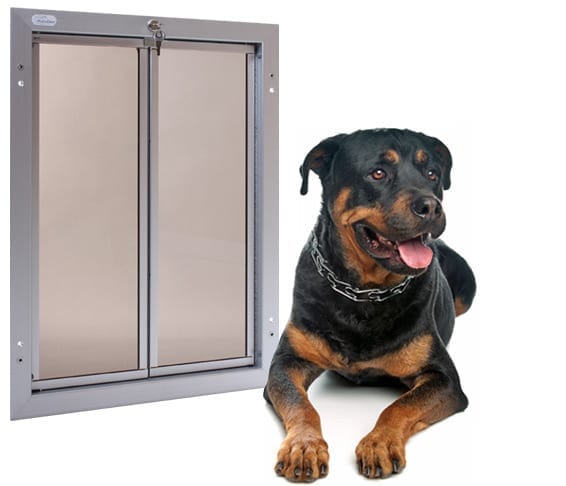
PlexiDor Extra LargeIf you need a pet door, the PlexiDor is sturdy, secure, energy efficient, and comes with a five year warranty. Here are answers to some frequently asked PlexiDor questions.


Where can I install a PlexiDor?

The PlexiDor can be installed through a door, a wall, or even through glass. The part you see next to the doggie on the picture goes on the inside of the house.

The PlexiDor units for door installation fits a standard US house door of 1.75″ and the frame covers the cut-out edges of the house door.
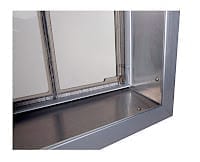
PlexiDor dog door wall tunnelThe units for wall installation come with an aluminum wall tunnel that is adjustable from 4″ to 12″ On the image to the right, the door is seen from the outside of the house. The aluminum tunnel is angled to drain water and snow to the outside.

When it comes to installations in glass, every size door from the small one to the extra large and the electronic PlexiDor can be mounted in a sliding glass door, french style door, or window.


What kinds of pets can use a PlexiDor?

The PlexiDor comes in several sizes to accommodate everything from cats to dogs weighing up to 200 lbs. The doors on the larger models swing so easily that smaller pets can use a bigger door.

If in doubt, check out thee PlexiDor SizeChart.

The door looks so small. Will my dog really go through there?

If you have the right size according to the PlexiDor SizeChart, the answer is generally “Yes.” The door isn’t meant to be mounted flush with the floor; the pets lift their legs and walk/run over a threshold. The reason for this is that you want the opening to be as small as possible while still being big enough for your pet.

Looking at the chart above, the extra large PlexiDor, for example, should be mounted 12″-14″ up from the floor, unless a dog needs it to be lower.


Is it hard to teach a pet to use the door?

Pets generally catch on to the idea quickly. Prop the panels open and tempt your cat or dog with a treat. Once they go through with the panels open, try the same thing with panels closed. Many pets who won’t use other pet doors still like the PlexiDor because they can see the other side through the panel.


What warranties do you have?

The PlexiDor comes with an unconditional 90 day money back guarantee. Shipping charges are non refundable, but the factory will refund the purchase price in full.

The PlexiDor also comes with a 5 year warranty. Any defective part will be repaired or replaced, including standard shipping charges, for five years from the purchase date. Labor is not covered.

This warranty covers residential use. Commercial kennels should use the BiteGuard line of pet doors.


Do you have a door that will let my dog out but keep the cats inside?

We can’t guarantee that. The PlexiDor Electronic opens only for pets with a key, but cats are quick and can follow the dog outside.


How does the PlexiDor Electronic work?

It’s like a miniature garage door for pets. The pets allowed to use the door get collar keys with RFID. The keys are waterproof, shock proof, and do not require batteries.

When the key comes close to the door, the panel slides up. You can program how long the door will stay open, and since there are thousands of RFID codes you can feel confident the door will only open for your pets, even if other animals in the neighborhood have similar keys.